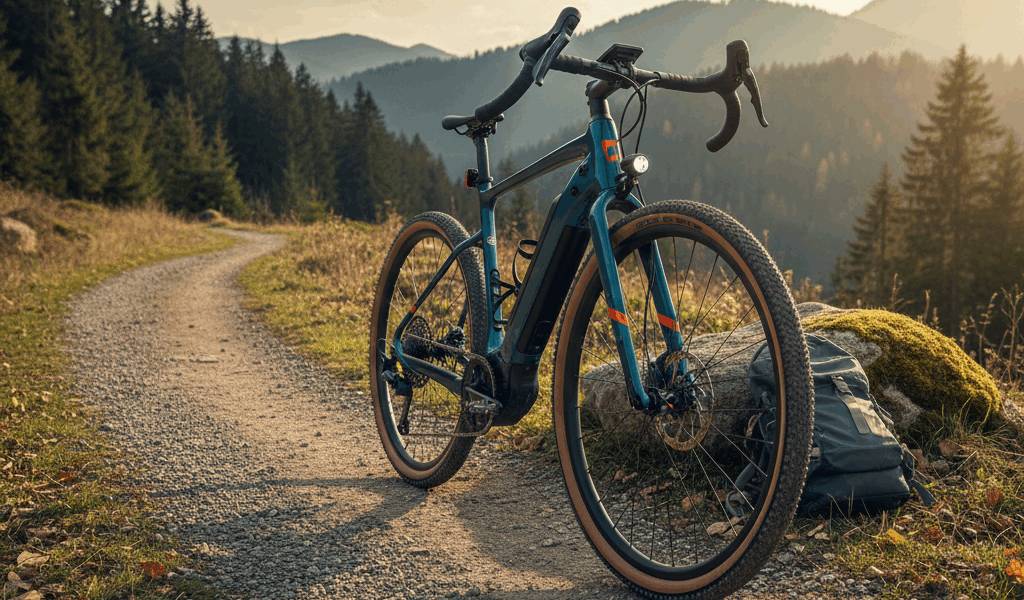
I resisted e-bikes for years. Rolled my eyes at them, honestly. Then a friend let me borrow his electric gravel bike for a long weekend in the Cascades and I covered more ground in three days than I’d managed in the previous two months combined. Rode up forest roads I would have turned around on halfway. Explored a ridgeline I’d been eyeing on the map for a year but never had the legs to reach. Finished every ride wanting to go again the next morning instead of needing two days on the couch.
Fine. I get it now. I was wrong.
Why Gravel Plus Electric

Road e-bikes exist, but they solve a problem most road riders don’t actually have. If you’re doing group rides on pavement, the motor creates this weird social dilemma — use it and feel like you’re faking it, or leave it off and wonder why you’re hauling an extra eight pounds of battery and motor for no reason.
Gravel is where the electric assist makes genuine sense. You’re usually solo or with one or two people. The routes involve steep fire roads, loose climbs where traction matters more than watts, and terrain that would otherwise just be a wall you can’t get over. The motor doesn’t pedal for you — it extends your range into places your legs alone won’t take you.
I’ve ridden gravel routes on my electric that I would never attempt on my acoustic bike. Not because I’m lazy, but because a 2,000-foot climb over five miles isn’t recreational for me. With assist, it’s manageable. Without, it’s suffering.
How the Power Works
Most e-gravel bikes worth buying use mid-drive motors — the motor sits at the bottom bracket and multiplies whatever force you’re already putting through the cranks. Push harder, get more help. Stop pedaling, motor shuts off instantly. It genuinely feels like having stronger legs rather than riding some kind of throttle-controlled scooter. The Specialized SL motor on my Creo is barely audible. The Bosch and Shimano EP8 systems on other bikes are a bit louder but still quieter than wind noise at any real speed.
Assist levels go from eco (around 30% extra power, barely noticeable on flat ground) up to turbo (150%+ boost, which is like having a tailwind up every hill). I live in eco mode for flat gravel and mild rollers, bump up to boost when the gradient hits double digits, and almost never touch turbo because it’ll drain a full battery in under 20 miles of climbing. You learn the assist levels the way you learn your gears — instinctively, after a few rides.
Battery range varies enormously depending on terrain, assist level, and rider weight. On mostly flat gravel, I can get 60-70 miles from a full charge in eco mode. Add serious climbing and that drops to maybe 35 miles. You learn to manage the battery like fuel.
What I Ride
I ended up with a Specialized Creo SL after test riding three different e-gravel bikes. Not cheap — I paid just under $7,000 for the Comp model — but at 27 pounds it’s closer to an acoustic gravel bike than to the 45-pound e-bikes that feel like pedaling a small motorcycle. People have ridden next to me and not realized it was electric until I told them. The SL motor has a subtle whine under load but you can’t hear it from ten feet away.
If $7,000 makes your eyes water (reasonable), there are real options at lower price points. The Giant Revolt E+ and Trek Domane+ LT are both solid around $4,000-5,500. Cannondale’s Topstone Neo is excellent but creeping into Creo price territory. Direct-to-consumer brands like Ride1Up and Aventon offer capable bikes in the $2,000-3,000 range — heavier frames, less refined motor integration, but genuinely rideable machines if you’re testing the waters.
Weight matters more on gravel than road because you’re constantly muscling the bike over rough terrain, picking lines through rock gardens, shouldering it over downed trees on backcountry routes. A 50-pound e-bike is fine on smooth gravel but becomes a real pain on anything technical. The lighter bikes cost more — that’s just the math — but they ride so much better that I’d rather buy a lighter used bike than a heavier new one.
The Fitness Argument
I’ve heard the “it’s not real exercise” argument dozens of times. My Garmin data says otherwise. Since getting the Creo, I ride four to five days a week instead of three. My weekly mileage jumped from around 80 miles to 120+. My actual fitness — measured by resting heart rate, sustained power on my acoustic bike, and how I feel climbing stairs — has measurably improved. Not because the e-bike makes me faster, but because I ride more often and recover faster between rides.
On a typical e-gravel ride, my average heart rate sits comfortably in zone 2-3 for two or three hours. That’s productive aerobic training by any coaching standard. The motor doesn’t eliminate effort — it caps the effort so a steep climb doesn’t spike me into zone 5 and wreck me for the rest of the route. I come home pleasantly tired instead of cooked.
For riders over 50, riders coming back from knee surgery or back issues, or riders who want to keep up with a stronger partner without destroying themselves — e-gravel bikes aren’t cheating. They’re the difference between riding and not riding.
The Downsides
Battery anxiety is real and I haven’t fully gotten over it. Running out of assist on a remote forest road with 15 miles and 1,500 feet of climbing still ahead — that’s a bad day. The motor goes dead, but you’re still pedaling a bike that weighs six pounds more than it should. I plan routes with a 20% battery margin and carry a small range extender on anything over 50 miles. Haven’t been stranded yet, but I’ve limped home on 2% charge more than once.
Maintenance is more involved than a regular bike. The motor and battery are additional systems that can develop issues your local shop may or may not know how to diagnose. My Creo has been in the shop twice for motor firmware glitches — once the assist cut out randomly mid-ride, once it wouldn’t pair with the app after an update. Both times it took a week to resolve because the shop had to work with Specialized support. That kind of downtime doesn’t happen with an acoustic bike.
And then there’s the price. A good e-gravel bike runs $5,000-10,000. For the cost of one Creo, I could have bought a top-tier acoustic gravel bike and a solid road bike and still had money left for a bikepacking setup. The value proposition only works if you’ll actually ride more — which I do, but it’s worth being honest with yourself about whether you will too.
Who Should Consider It
If you live somewhere hilly and the terrain limits where you’re willing to ride, an e-gravel bike genuinely changes the math. If you want to ride with a partner who drops you on every climb, it levels things out. If you’re curious about routes that are currently beyond your fitness, this is how you get there while you build toward doing them unassisted.
If you’re already riding happily on acoustic bikes and the hills aren’t stopping you — there’s nothing to fix. Don’t buy an e-bike because the internet told you to. The electric assist isn’t universally better. It solves specific problems that may or may not apply to your riding.
I still own my acoustic gravel bike. Ride it twice a week, usually on the shorter local loops where the motor would just be dead weight. But when Saturday rolls around and I’m planning a big route with real climbing and unfamiliar terrain? I grab the Creo every single time. The places it’s taken me are worth every penny and every pound.

Leave a Reply