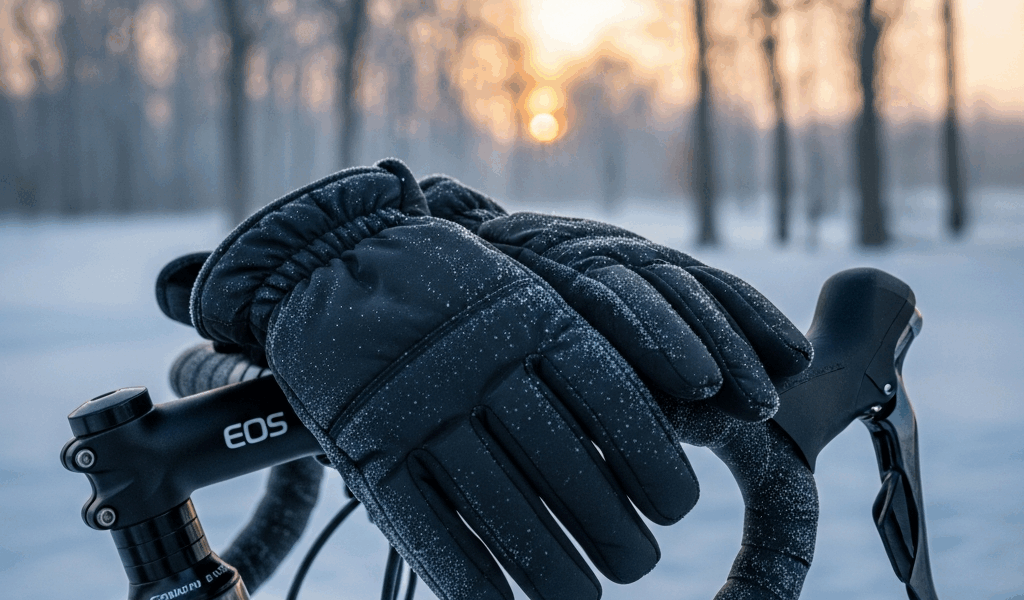
Why Most Cycling Gloves Fail Below 35°F
Winter cycling gear has turned into a moving target with all the “best of” lists and sponsored reviews flying around. As someone who commutes by bike through Minnesota winters, I taught myself the working side of what actually keeps your hands functional when temperatures drop below freezing. Today, I will share it all with you.
This article includes affiliate links. We may earn a commission at no extra cost to you.
But what is a true winter cycling glove? In essence, it’s insulated handwear built for sustained sub-freezing riding with wind exposure. But it’s much more than that — it’s the difference between finishing your commute and turning around at mile three because your fingers are screaming at you.
Here’s the thing nobody talks about. Below 35°F, wind speed rewrites the rules entirely. A 15 mph commute in 25°F air hits your fingers like minus 10°F. Throw in sweat building up inside the glove — or rain that’s deciding whether to stay liquid — and even decent insulation becomes a suggestion rather than a solution.
Most winter cycling gloves prioritize bar feel over actual warmth. That’s the dirty truth. Manufacturers know thick insulation dulls handlebar feedback, slows your shifts, softens braking response. So they compromise — moderate synthetic fill, maybe some thin merino, and a quiet bet that you’ll tolerate numb fingers in exchange for better control. Below 35°F, that bet loses every single time.
Three years ago, I bought a pair of Pearl Izumi gloves. Well-reviewed. Rated for “cold weather.” Wore them on a 28°F morning. By mile three, my shifters were strangers to me. By mile five, my hands weren’t numb — they were in genuine pain. I turned around. Those gloves had maybe half an inch of synthetic fill. Fine for 40°F with a tailwind at your back. Completely useless for sustained sub-freezing riding with any wind at all. Don’t repeat what I did.
Best Gloves for 25–40°F Riding
So, without further ado, let’s dive in. If you’re commuting in that 25°F to 40°F window, you need specific models — not what cycling magazines recommend, but what serious winter riders actually pull off the shelf and buy with their own money.
Lobster Gloves — The Bar Feel Winner
Lobster gloves split your fingers into two compartments: index and middle finger sharing one pocket, ring and pinky in another. Warmer than traditional five-finger gloves. More feedback than full mittens. That’s what makes lobster gloves endearing to us cold-weather commuters — they exist in exactly the right middle ground.
The Pearl Izumi AmFib Lobster Glove runs $60–$75. It uses a Gore Infinium shell — stretchy, wind-blocking, breathes noticeably better than neoprene. Insulation sits around 200g synthetic. Not paper-thin, not bulky. Real riders put these around 32°F as the reliable floor. Push below that, and you’re gambling.
Giro makes a solid lobster option too. The Giro Supernatural Lite at $55 uses similar wind-blocking construction but thinner fill. Honestly better suited for the 35–45°F range than deep cold. The fit runs tighter than Pearl Izumi — some riders prefer that, others find it cuts circulation after an hour.
Gore Infinium Shell as the Game Changer
Gore Infinium deserves its own paragraph. It’s a specific membrane — stretchy, genuinely wind-blocking, more breathable than rubber or neoprene alternatives. Spot it on a spec sheet and treat it as a quality signal. You’ll pay roughly $10–15 more per pair, but wind stays out without trapping sweat against your skin.
Sealskinz builds high-end models around it. Their All Weather Gloves at $90 are honestly overkill for the 25–40°F range — they’re engineered for below 20°F. Three-layer construction, 300g insulation, waterproof insert. The Cadillac option. Worth knowing about when temperatures get genuinely brutal.
The Budget Alternative That Works
While you won’t need to drop $75 on gloves to survive winter commuting, you will need a handful of qualities — wind blocking, adequate fill, and a fit that doesn’t bunch. Decathlon’s B’Twin Winter Cycling Gloves at $30 check those boxes for 30–40°F riding. Synthetic insulation, wind-blocking nylon shell, no frills. I tested a pair and wore them for a full month of commuting. Warm enough at 35°F. Below 30°F, they got marginal — but at that price point, remarkable is the right word.
The catch: they’re only sold at Decathlon physical locations in North America. Not online. If a store sits near you, worth the trip.
Below 25°F — When You Need Pogies or Mittens
Here’s the part worth saying first. If you’re riding in real winter — 25°F, 15°F, minus 5°F — gloves alone aren’t the answer. You need pogies or full mittens, and you need to make peace with the trade-offs upfront.
Frustrated by perpetually frozen hands, a Minneapolis commuter I know switched to bar mitts last January and never went back to standalone gloves for winter riding. I understood completely when he told me.
Pogies are insulated pouches that wrap around your handlebars. Hands sit inside, shielded from wind, radiating warmth back at themselves. You wear thin gloves underneath — just to manage sweat and keep grips dry. The system holds up reliably to about 10°F. Below that, you’re relying on personal chemistry and layering strategy.
The sacrifice is real. Shifting slows down. Your hands stay tucked inside most of the time, and pulling out to change gears or brake hard means a moment of exposure before tucking back in. On a short commute, that’s fine. On longer rides with constant gear changes, it grinds on you. But if not suffering is the priority — and it should be — pogies win without much debate.
Bar Mitts at $40–50 are the standard. Neoprene outer, fleece inner, velcro closure. Mount in seconds. Fit drop bars and flat bars equally well. Not pretty. They work. Specialized sells a version around $45 with marginally better materials, but the functional difference is essentially nothing.
Full mittens — one undivided space for your entire hand — run warmer but hurt bike control significantly. Save those for stationary riding or very short trips. They’re not practical for actual commuting.
The Layering Hack — Thin Liner Plus Shell
Here’s the approach that actually works across a wide temperature range without owning five separate pairs of gloves. A thin merino liner under a wind-blocking shell glove. Simple. Adaptable. Cheaper than buying dedicated gloves for every 10-degree band of weather.
The thin merino liner — $25–35 — does two jobs. It manages sweat because merino absorbs moisture without that clammy synthetic feeling. It adds modest insulation, maybe 50–75g equivalent. The real value is flexibility.
Smartwool makes a fine merino liner. So does Icebreaker. Both run around $30. I’m apparently a medium in Smartwool and Icebreaker works for me while cheaper synthetic liners never quite managed the moisture the same way. Either brand fits snugly under a shell glove — no bunching, no restriction.
The shell glove at $45–70 should be a lightweight wind blocker. Thin synthetic fill, stretchy Gore Infinium or similar membrane, snug cut. The Giro Supernatural Lite works here. So does the Pearl Izumi AmFib in a trimmed-down size.
At 45°F, wear just the liner. At 35°F, add the shell. At 25°F, wear both — toss a pogie on if needed. Two pieces of gear covering 40 degrees of temperature range. A single thick glove can’t do that. It’s a fixed solution to a variable problem.
I started doing this three winters ago and it killed the problem dead. One pair of merino liners, two shell gloves with one living in my commuter bag, covered from October through March without a gap.
Total cost: around $105. These pieces last five winters minimum with basic care.
The honest truth about winter cycling gloves — there’s no single magic pair. But map the temperature ranges, accept the feel-versus-warmth trade-offs, and build the layering system, and you’ve solved 90% of it. Below 25°F, your hands will never be genuinely comfortable on a bike. That’s physics refusing to negotiate. What you can do is make them survivable and keep the commute moving. That’s the actual win.


Leave a Reply