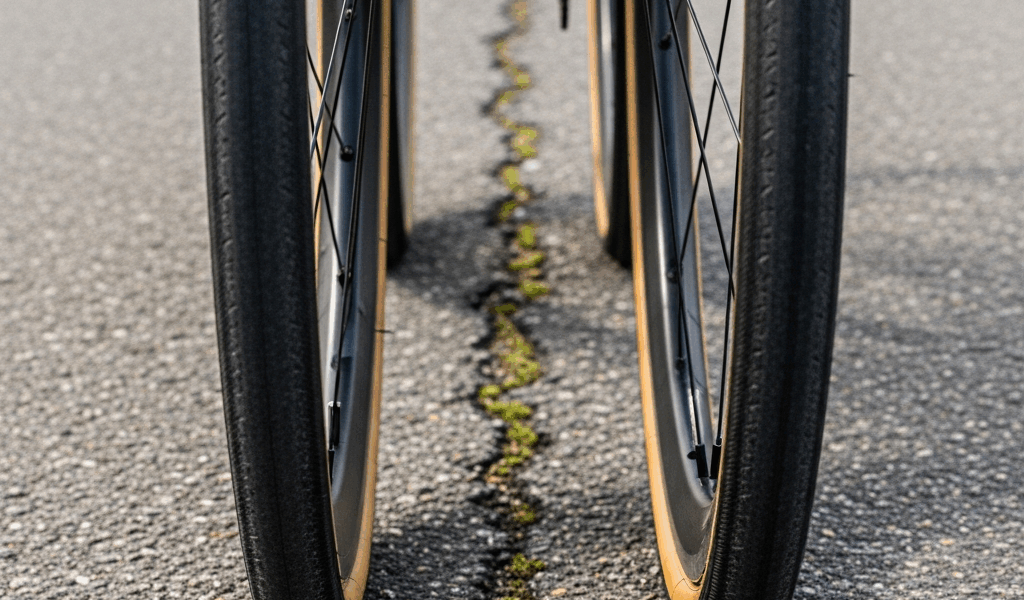
You’re looking at new tires for your road bike and the shop has 25mm and 28mm sitting side by side on the shelf. Your bike came with 25s. Half the people at the group ride swear 28s changed their riding. The other half say 25s are faster and anything wider is marketing hype. Both groups sound very confident.
Here’s what the tire width actually changes on the road, and which size makes sense for how you ride.
Rolling Resistance: The Speed Difference Is Smaller Than You Think
For years, the assumption was narrower = faster. Thinner tires have less rubber on the road, less drag, more speed. It sounds logical, and it was the standard advice through the early 2010s.
The data tells a different story. Independent rolling resistance tests (Bicycle Rolling Resistance) consistently show that at equivalent tire pressure, 25mm and 28mm tires from the same manufacturer roll within 1-2 watts of each other at typical road speeds. At 20 mph, that’s less than 1% difference. You’d never feel it.
The wider 28mm tire actually has a flatter contact patch — shorter and wider rather than long and narrow. This distributes the deformation more evenly and reduces energy lost to casing flex. On rough road surfaces, 28mm tires roll faster than 25mm because they absorb bumps instead of bouncing over them. Every bounce is energy your legs produced that went into vertical movement instead of forward momentum.
Comfort: Where 28mm Wins Decisively
Run a 25mm tire at 90 PSI and a 28mm tire at 75 PSI. Both achieve roughly the same tire drop (how much the tire deforms under your weight). But the 28mm at lower pressure absorbs road vibration dramatically better.
On smooth asphalt, the difference is subtle — a slightly softer ride, less buzz through the handlebars. On chip seal, broken pavement, or any real-world road surface with imperfections, the difference is immediate. Your hands don’t go numb at mile 40. Your back doesn’t seize up at mile 60. You arrive at the end of a century feeling noticeably less beaten up.
For riders over 170 pounds, the comfort gap widens further. Heavier riders need higher pressures on 25mm tires to avoid pinch flats, which makes the ride harsher. The 28mm tire accommodates the same rider weight at lower pressure with better flat protection.
Aerodynamics: 25mm Has a Small Edge
At speeds above 25 mph, aerodynamic drag is the dominant force working against you. A 25mm tire presents a narrower frontal profile — roughly 3mm less than a 28mm — which reduces wind resistance by a small but measurable amount.
In wind tunnel testing, the difference between 25mm and 28mm is approximately 2-3 watts at 30 mph. At 20 mph — where most recreational and club cyclists ride — the difference drops below 1 watt. Unless you’re racing time trials or competing in crits where every watt counts at 28+ mph sustained effort, the aero advantage of 25mm tires is smaller than the watt savings from wearing a tighter jersey.
One caveat: rim width matters. Modern wide rims (19-21mm internal width) optimize airflow with 28mm tires better than older narrow rims. If your wheels have 15-17mm internal width, 25mm tires will sit more aerodynamically than 28mm tires that mushroom outward past the rim edge.
Frame Clearance and Compatibility
Check your frame before buying 28mm tires. Not every road bike accepts them. Older frames (pre-2016), especially race-geometry bikes, often have tight clearances around the brake calipers and seat stays. You need at least 4mm of clearance between the tire and frame at the tightest point — anything less risks rubbing under load or in wet conditions when mud collects.
Most bikes made after 2018 clear 28mm tires without issue. Many endurance and gravel-influenced road frames clear 32mm. Check your manufacturer’s spec sheet or physically measure the gap with your current tires.
If your frame maxes out at 25mm, that’s your answer — don’t force a 28mm tire into a frame that wasn’t designed for it. The consequences range from annoying (tire rub on hard cornering) to dangerous (brake pad contact with the tire sidewall).
The Right Choice for Your Riding
Choose 25mm if: You race crits or time trials at 25+ mph sustained. Your frame doesn’t clear 28mm. You ride exclusively on smooth, well-maintained roads. You’re under 150 pounds and don’t need the extra volume for comfort.
Choose 28mm if: You ride centuries, gran fondos, or club rides. You care about comfort on 3+ hour rides. You ride on mixed road surfaces (chip seal, patchy pavement, occasional gravel). You weigh over 160 pounds. Your wheels have modern wide rims (19mm+ internal).
For most road cyclists in 2026, 28mm is the better choice. The speed penalty is negligible at real-world riding speeds, the comfort improvement is significant, and the flat protection at lower pressures is a practical advantage on any ride over 2 hours. The pro peloton has moved to 28mm and 30mm for Grand Tours — and they have the wind tunnel data to justify every decision. If 28mm is fast enough for the Tour de France, it’s fast enough for your Saturday group ride.



Leave a Reply