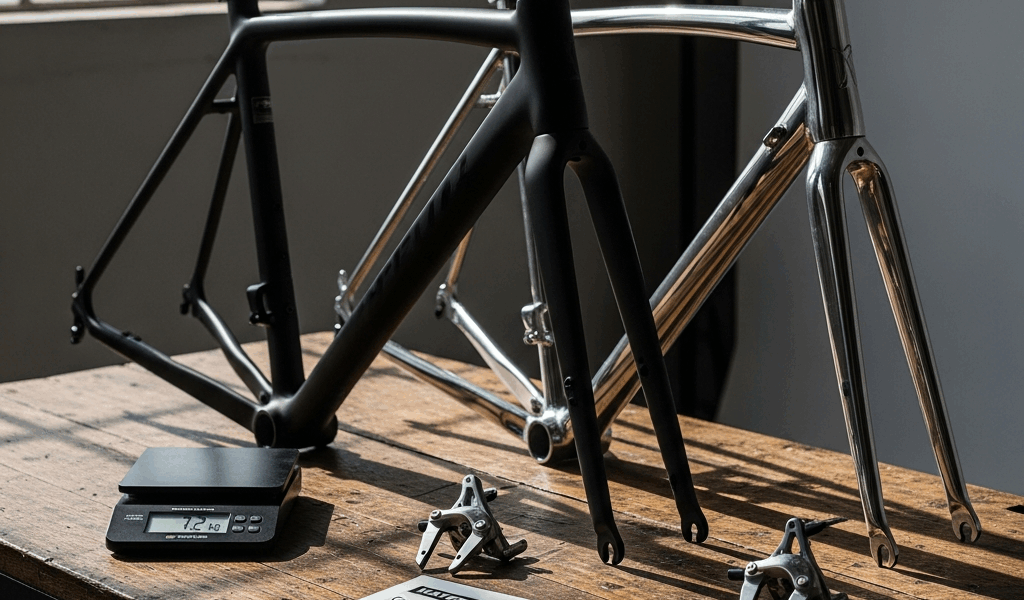
Carbon vs Aluminum Road Bike — Which One Is Right for You
The carbon vs aluminum debate has gotten complicated with all the sponsored content and materials-science noise flying around. As someone who spent three years on a Giant Contend AL 2 before switching to a Trek Émonda SL 6, I learned everything there is to know about what actually separates these two frame types. Today, I will share it all with you. Spoiler: the honest answer is more boring — and more useful — than most reviews let on.
This article includes affiliate links. We may earn a commission at no extra cost to you.
The Real Difference Between Carbon and Aluminum
But what is the actual distinction here? In essence, it’s weight and manufacturability. But it’s much more than that.
A typical aluminum endurance frame runs 900g to 1,100g. A comparable carbon frame sits between 750g and 900g. That’s a 200g–350g gap at the frame level — real, but not dramatic. Carbon’s bigger trick is directionality. Engineers can tune a carbon layup to be stiff in one axis and forgiving in another. Aluminum can’t do that. It’s isotropic, meaning it behaves roughly the same in every direction regardless of what you want it to do.
The price gap exists for a straightforward reason. Each layer of carbon fabric gets laid up by hand — or with robotic precision — inside a mold, then cured under heat and pressure, then inspected. Aluminum frames are extruded, welded, and heat-treated. Faster. Cheaper. You’re not paying extra for carbon because it’s exotic. You’re paying for production hours. At the $1,500–$3,500 range, that difference shows up as roughly $800–$1,200 between comparable builds. That’s just manufacturing math.
Think of this article as a decision tool, not a composite materials lecture. By the end, you’ll know exactly which direction to go based on your riding volume, your budget, and how much you genuinely care about things like climbing weight and long-term durability.
Ride Feel — What You Actually Notice on the Road
Here’s where I’ll push back on almost everything you’ve read. Carbon does damp high-frequency vibration better than aluminum — in a lab. On actual roads, at the $2,000–$3,000 price point, the difference is smaller than the marketing suggests. Much smaller.
Frustrated by how little I could feel between the two frames, I spent several weeks paying close attention on the same routes with the same body. The biggest variable wasn’t frame material at all. It was tire width and pressure. Running 28mm tires at 70 psi versus 25mm tires at 95 psi changed the ride quality more dramatically than going from aluminum to carbon ever did. A set of 28mm Continental GP5000s at reasonable pressure — around $65–$75 each — will do more for road comfort than a carbon frame upgrade at the same price point.
That said, carbon bikes in the $2,500-and-up range often arrive with better component packages overall. Better saddles, better handlebars, sometimes a carbon seatpost already installed. Those components collectively improve ride feel. The frame material itself deserves less credit than it typically gets. Tire pressure matters. Saddle fit matters. Bar height matters. Frame material is somewhere further down the list for most riders — honestly, pretty far down.
Weight and Performance — Does the Gap Matter at Your Level
Two hundred grams. That’s the real-world frame weight difference between a mid-range aluminum frame and a comparable carbon one. A standard 600ml water bottle filled with water weighs about 600g. So we’re talking about a third of a water bottle. That’s what the upgrade costs you, weight-wise.
For riders doing under five hours a week — or anyone not racing — that gap is genuinely hard to feel. I kept my full water bottles on a 4,000-foot climbing day and added more weight than any carbon frame upgrade would have saved. The math just doesn’t lie.
Where weight actually matters:
- Sustained climbing — On long alpine-style ascents over 30 minutes, lighter riders on lighter bikes do have a measurable advantage. Racing or doing gran fondos with serious elevation? Two hundred grams compounds over time.
- Repeated accelerations — Criterium racing, punchy group rides with frequent surges. Rotating mass and total bike weight affect how quickly you respond to attacks.
- Your ego on Strava — Valid, honestly, but be honest with yourself that this is what’s driving the decision.
If you’re riding 50 miles a week on mixed terrain and want to get faster, spending $800 on better wheels will outperform spending $800 on a carbon frame upgrade. Every time. Rotational weight matters more than static frame weight for most riding scenarios — at least if you’re not racing professionally.
Durability, Crash Risk, and Long-Term Cost
Probably should have opened with this section, honestly — because this is the part most comparison articles either skip entirely or bury in vague reassurances.
Aluminum dents. Carbon cracks. Both are real failure modes. Neither is catastrophically worse than the other under normal riding conditions. The problem with carbon damage is that it’s not always visible. A hard impact — a crash, a dropped bike, a car door — can cause internal delamination that looks perfectly fine from the outside but has quietly compromised the frame’s structural integrity. With aluminum, damage is usually obvious. A dent. A crumple. A crack you can actually see. You know what you’re dealing with immediately.
Carbon frame inspection after a crash typically costs $75–$200 at a shop equipped to do it properly. A structurally compromised carbon frame isn’t safely repairable in most cases — you replace it. A cracked aluminum frame is also usually a replacement, but entry-level aluminum framesets run $300–$600. A carbon frameset at the same performance level starts around $900 and climbs fast from there.
Resale value tilts toward carbon. A used carbon road bike holds value better than aluminum at equivalent price points — which matters if you’re buying a $2,800 bike and planning to sell it in three years to fund an upgrade. Factor that into your total cost calculation before deciding.
One more honest note. If you commute on your road bike, ride in variable weather, or lock it up anywhere outside your living room, aluminum is more forgiving of life happening to your bike. The dent risk feels worse than it is. The invisible-damage risk of carbon feels better than it is. Don’t make my mistake of underestimating that second part.
Which One Should You Actually Buy
So, without further ado, let’s dive into the actual framework.
- Budget under $2,000 — Buy aluminum. Spend the $400–$600 you saved on a better wheelset or groupset. A Shimano 105-equipped aluminum bike like the Trek Domane AL 4 or the Cannondale Synapse 105 will outperform a Tiagra-equipped carbon bike in real-world riding. Components win over frame material at this price tier. Full stop.
- Budget $2,000–$2,500 — This is the gray zone. Riding fewer than 75 miles a week? Aluminum still makes more practical sense. Pushing toward 100 miles a week with ambitions of racing or organized events? Stretch to carbon — at least if you’re willing to be realistic about your timeline.
- Budget $2,500 and above, riding 100+ miles per week — Carbon makes sense here. Component packages on carbon bikes at this level are substantially better, frame quality improves meaningfully, and you’ll ride it enough to feel the cumulative benefits. The Trek Émonda SL 6 and the Specialized Tarmac SL6 are useful benchmarks for comparison shopping in this range. Interestingly, the Specialized Allez Sprint — aluminum — competes here too, which tells you something worth remembering.
I’m apparently a “three-to-four days a week, 50–100 miles weekly” rider with a $2,000–$2,800 budget, and the aluminum-first approach works for me while chasing carbon early never did. That’s the most common buyer profile for this decision anyway. For that rider, my direct recommendation is this: buy the best aluminum bike you can find with a Shimano 105 or SRAM Rival groupset, then upgrade wheels in year two. You’ll ride faster, spend less, and have money left over for the things that genuinely change your performance — a professional bike fit at around $200–$350, coaching, and better tires.
That’s what makes the aluminum option endearing to us practical riders. The frame material is the last thing that will limit you. Your fitness is the first.

Leave a Reply