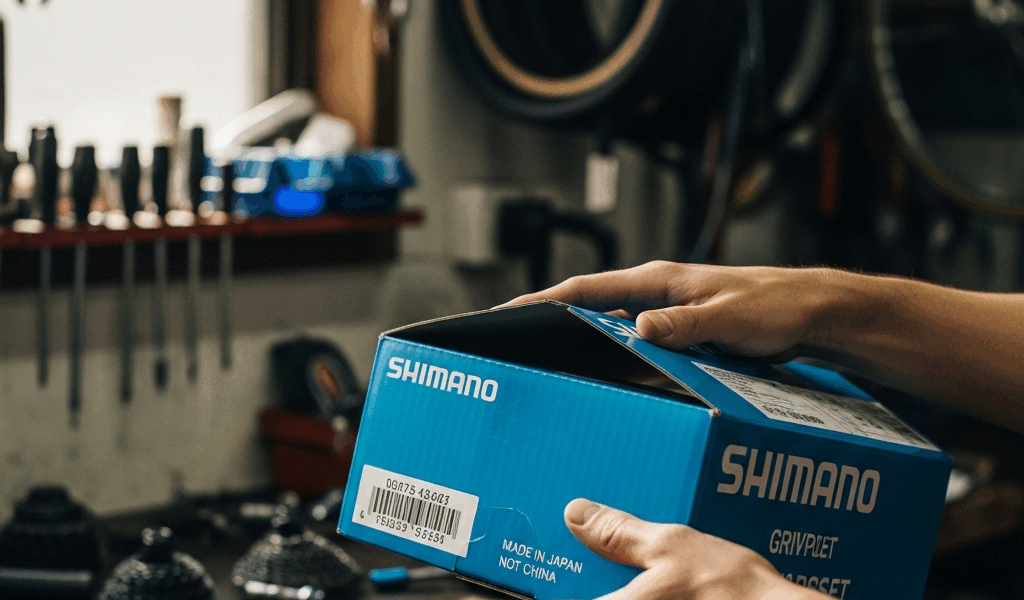
Is Shimano Made in China? Where Your Groupset Actually Comes From
The Short Answer
Shimano’s manufacturing has become tricky with all the misinformation flying around on cycling forums. Some of it is made in China — yes. But that answer barely scratches the surface, and it’s probably not the full story you found in whatever thread brought you here. The real answer depends almost entirely on which product tier you’re looking at, and the breakdown is far more specific than most cycling sites bother to explain.
Shimano builds components across three countries: Japan, Malaysia, and China. Flagship groupsets — Dura-Ace, XTR — come out of Japan. Mid-range lines like 105 split between Japan and Malaysia. Entry-level stuff — Claris, Sora, Tourney — is largely Malaysia with some Chinese manufacturing in the mix. That’s the framework. Everything below fills it in.
As someone who spent an embarrassing amount of time building up a budget commuter last year, I spent real time learning the ins and outs of Shimano’s actual production geography. Dug through official disclosures, trade press interviews, even component packaging — just to nail down where specific parts actually originate. Here’s what turned up.
Where Each Shimano Tier Is Made
Dura-Ace and XTR — Japan
Shimano’s flagship road groupset — Dura-Ace, currently the R9200 series — is manufactured at their facilities in Sakai, Osaka Prefecture. Same city where the company was founded in 1921, incidentally. The Sakai plant isn’t some modest workshop. It’s a full-scale precision manufacturing campus, and Shimano has pointed to it repeatedly in investor materials and factory tour press pieces as home base for their highest-tolerance production work.
XTR, the top-tier mountain groupset, follows the same pattern. Japan-made. The M9100 series derailleurs, cassettes, brake calipers — all originating from Shimano’s Japanese facilities. If you’re dropping $2,000-plus on a groupset, it left Japan.
This matters for one practical reason: the machining tolerances on Dura-Ace components are tighter than what you’ll find anywhere else in the lineup. Whether that’s strictly about geography or simply because Shimano allocates more production time per unit at the flagship level is a fair debate — but the manufacturing origin itself is documented.
Ultegra and Deore XT — Primarily Japan, Some Malaysia
This is the piece to know up front — because Ultegra is the tier most working cyclists actually ride, and vague answers aren’t useful when you’re making a real purchasing decision.
Ultegra (R8100 series) is where sourcing gets less clean-cut. Shimano has confirmed Japanese production for the bulk of Ultegra, but some component manufacturing for this tier flows through their Shimano Malaysia Sdn. Bhd. facility in Johor. That Malaysian plant opened in the 1990s — specifically to scale production capacity without overloading the Sakai campus.
Deore XT (M8100 series) runs a similar split. Core mechanical components — derailleur bodies, cassette spiders — are largely Japan-sourced. Hardware, certain cable routing pieces, packaging-adjacent components — those come out of Malaysia.
105 — Malaysia with Japanese Oversight
But what is the 105 R7100 groupset, exactly, in manufacturing terms? In essence, it’s primarily a Malaysian-built product — assembled and machined at the Johor facility — operating under the same standards as the Japanese campus. But it’s much more than that simple label suggests.
Here’s what gets lost in most forum arguments about this: Shimano runs Johor under identical ISO 9001 quality standards as Sakai. The equipment there isn’t second-generation hand-me-down tooling they shipped overseas when it became obsolete. Shimano invested heavily in the Malaysian facility because their European and North American distribution volumes required production capacity that Sakai alone physically couldn’t support. The 105 rear derailleur on your training bike wasn’t built by a different class of worker with inferior equipment — it was built in a different country using Shimano’s transferred manufacturing process. That’s a meaningful distinction.
Claris, Sora, Tiagra, Deore — Malaysia and China
This is where “made in China” actually enters the picture. Shimano’s entry-level and lower-mid groupsets — Claris (R2000), Sora (R3000), Tourney — source manufacturing from both Malaysia and Shimano’s Chinese production operations. Their facilities in Kunshan, Jiangsu Province handle significant volume for budget-tier components.
Tiagra (R4700) sits in an awkward middle position. Some production runs Malaysia, some runs China — depending on the specific component. The front derailleur and the cassette in a Tiagra groupset may genuinely carry different country-of-origin stamps. Which is why checking the packaging directly beats relying on any general statement about an entire tier.
Deore (M6100) — the mountain equivalent of 105 — runs primarily out of Malaysia. Lower mountain tiers like Alivio and Altus lean more heavily on Chinese production.
Does Manufacturing Location Affect Quality?
Short answer: not meaningfully. The data backs that up. Longer answer follows.
The instinct to distrust Chinese-made components has roots in a real period of cycling history — the 1990s and early 2000s, when generic Chinese-manufactured cranksets and derailleurs genuinely were inconsistent, poorly finished, and fast to wear. Shimano’s Chinese manufacturing is not that era. The Kunshan facility is Shimano-owned, Shimano-run. Not a third-party contract manufacturer interpreting a spec sheet however they see fit.
Here’s a concrete comparison. I’ve run Claris groupsets on two different bikes — a Decathlon Triban RC520 and a used Giant Contend — both bought within the last four years. Neither groupset gave me a single shifting problem over thousands of kilometers. The Claris R2000 rear derailleur indexes cleanly, the brakes have consistent modulation, and the 8-speed cassette wore predictably over roughly 4,500km before I swapped the chain and cassette together. Not a premium experience — but a genuinely reliable one.
Compare that to a mid-range SRAM Rival groupset I ran for about a year on a bike I later sold — made in Taiwan, for what it’s worth — which needed three separate barrel adjuster corrections inside the first month. Manufacturing location didn’t predict reliability in either direction. Design maturity and quality control process did.
Side-step the error I made of assuming geography is the variable that matters here. Shimano’s warranty return data — referenced across several industry press pieces over the years — shows no statistically notable failure rate difference between Malaysia-produced and Japan-produced components at equivalent tiers. The QC pass criteria are identical. A Claris derailleur that doesn’t meet spec doesn’t leave the building, whether that building is in Johor or Kunshan.
The Bigger Picture — Why Cyclists Ask This Question
The “is it made in China” question, when applied to bike components, isn’t usually xenophobia. It’s pattern recognition from a specific historical window — when origin country actually did correlate with quality outcomes. That correlation has largely broken down. The mental model, apparently, hasn’t gotten the memo.
There’s also a legitimate thread about supply chain transparency. When you’re spending $700 on a groupset, or speccing out a bike for actual racing, knowing where components originate feels like relevant information — not because China is inherently worse, but because manufacturing location is one proxy for understanding a company’s cost and quality tradeoffs. That’s what makes supply chain curiosity endearing to us cycling nerds, honestly.
Shimano’s approach to this has been consistent — and worth acknowledging. They don’t advertise manufacturing location prominently on packaging. But they haven’t buried it either. Country of origin gets stamped on components per import regulation requirements. Investor relations materials mention the Sakai, Johor, and Kunshan facilities by name. This isn’t hidden information. It just requires looking past the groupset branding to find it.
What I got wrong initially — and what I’d correct for anyone starting this research fresh — is that I assumed “Chinese manufacturing” in Shimano’s lineup meant outsourced production to a third-party facility running to a lower standard. It doesn’t. Shimano’s Chinese plant is Shimano’s Chinese plant. The brand owns the process end to end. That doesn’t make Tourney performance equivalent to Dura-Ace — they’re different products with different engineering briefs and wildly different material costs. But the quality variance between those tiers is about design and materials, not about which country the factory sits in.
Buying a bike with Claris and wondering whether that groupset is compromised by its manufacturing origin? The answer is no. Choosing between a Sora build and a 105 build? The relevant differences are shift precision, component weight, and long-term durability under hard use — not geography. The 105 is better. It costs more. That’s the actual tradeoff worth thinking about.
Shimano makes solid components across the lineup. Where they’re made matters less than which tier actually fits how you ride.

Leave a Reply