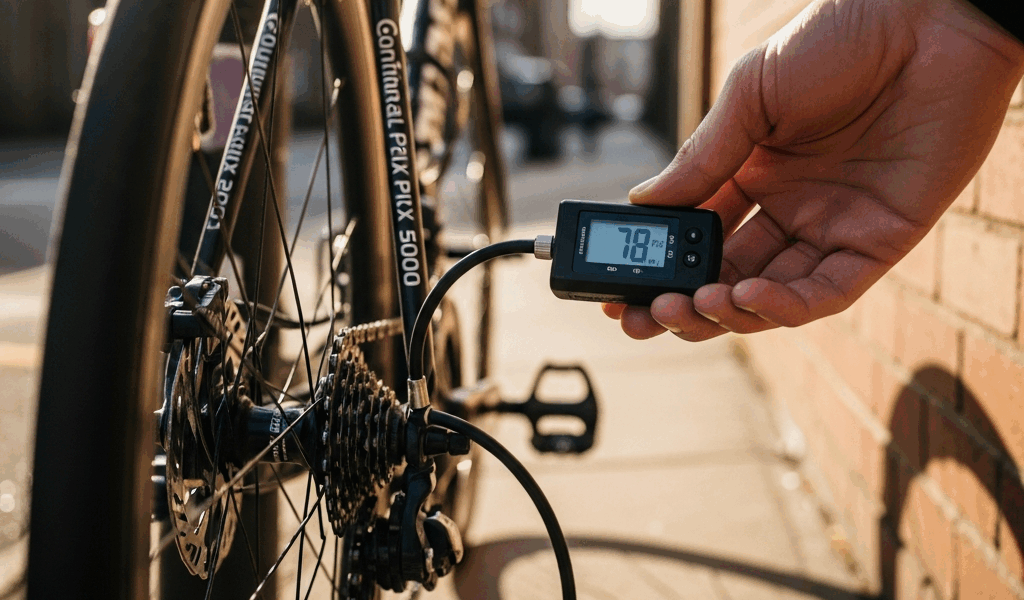
Road Bike Tire Pressure by Weight — The Chart That Actually Works
Road bike tire pressure has started getting harder to follow with all the conflicting advice flying around. Most guides hand you some vague range — “80 to 120 PSI for road bikes” — and call it a day. That’s about as useful as telling someone to eat “some food.” As someone who’s been riding road bikes for about twelve years, I taught myself the working side of this the hard way. Spent an embarrassing chunk of that time pumping my tires to whatever the sidewall said — maximum pressure, which is almost never the right pressure. My rides felt brutal, cornering in the wet made me nervous, and I kept wondering why my back was wrecked after anything over 40 miles. The answer was sitting right there next to my floor pump the whole time.
What actually matters is the intersection of your weight and your tire width. Those two variables drive the number more than anything else. This article gives you a real chart — specific front and rear PSI values — plus enough context to know when to ignore it.
The Tire Pressure Chart
One thing before you dive in. The front and rear columns are intentionally separate — more on the why in the next section, but the short version is your weight doesn’t split evenly between both wheels. These numbers assume a clincher tire with a standard butyl inner tube, ridden on pavement in dry conditions. Tubeless riders, keep reading — there’s a separate section for you.
The chart covers rider weight from 120 to 220 lbs across the three most common road tire widths: 25mm, 28mm, and 32mm. Running 23mm tires? Add roughly 5 PSI across the board. On 35mm or wider? Subtract about 5 PSI.
| Rider Weight (lbs) | 25mm — Front | 25mm — Rear | 28mm — Front | 28mm — Rear | 32mm — Front | 32mm — Rear |
|---|---|---|---|---|---|---|
| 120 lbs | 76 | 82 | 68 | 74 | 58 | 64 |
| 130 lbs | 79 | 85 | 70 | 76 | 60 | 66 |
| 140 lbs | 81 | 88 | 72 | 79 | 62 | 68 |
| 150 lbs | 84 | 91 | 74 | 82 | 64 | 71 |
| 160 lbs | 87 | 94 | 77 | 85 | 66 | 73 |
| 170 lbs | 89 | 97 | 79 | 87 | 68 | 76 |
| 180 lbs | 92 | 100 | 82 | 90 | 70 | 79 |
| 190 lbs | 95 | 103 | 84 | 93 | 72 | 81 |
| 200 lbs | 97 | 106 | 87 | 96 | 74 | 83 |
| 210 lbs | 100 | 109 | 89 | 99 | 76 | 86 |
| 220 lbs | 103 | 112 | 92 | 102 | 79 | 89 |
Stare at this for a minute and a couple things jump out. A 120-lb rider on 32mm tires runs close to the same PSI as a 120-lb rider on 25mm tires — but the rides feel nothing alike. Wider tires carry that pressure across a much larger air volume, so you get dramatically softer feel even when the numbers look similar. Also — nobody should be running 120 PSI in road tires. That number stamped on your sidewall is a maximum rating, not a suggestion. Avoid the path I took. I ran my old Vittoria Zaffiro Pros at 120 PSI for about six months before a club rider caught me mid-pump one Saturday morning and physically stopped me.
Why Front and Rear Pressure Should Be Different
Quick callout up front. It’s the part most people get wrong before they’ve even glanced at any chart.
On a road bike in a typical riding position, roughly 40% of the combined system weight — you plus the bike — sits over the front wheel. The rear takes the other 60%. The exact split shifts a little depending on your fit and frame geometry, but 40/60 is the standard working assumption tire engineers at places like Michelin and Continental use when they build their own pressure calculators. That’s what makes this split so endearing to us riders — it’s not guesswork, it’s physics that’s been validated by the people actually making the tires.
That load imbalance means the rear tire works harder. It deforms more under load, runs hotter on long descents, and takes more abuse from road debris — it’s always tracking through the exact line your front wheel already cleared. Running identical PSI on both wheels ignores all of that. The rear needs more pressure to handle the extra weight and resist pinch flats. The front needs less to conform to road texture and give you actual feel through the bars.
The practical gap lands at 5 to 10 PSI. Look at the chart — a 170-lb rider on 28mm tires runs 79 PSI front and 87 PSI rear. That 8 PSI difference isn’t arbitrary. It reflects real weight distribution. Run equal pressure on both ends and one of two things happens: your front is overinflated — harsh, skittish in corners — or your rear is underinflated and rolling sluggishly with elevated flat risk. Neither is good.
Frustrated by back-to-back flats on a 2022 century ride through rural Ohio, I finally started separating my pressures deliberately — front 82 PSI, rear 90 PSI on my 28mm Specialized S-Works Turbo tires. The handling on descents changed immediately. The front stopped feeling like it was skating across smooth pavement.
Tubeless vs Tubes — How It Changes the Numbers
Running tubeless — something like Hunt 4 Season Aero Disc wheels with Orange Seal Endurance sealant inside — you can drop the chart numbers by 5 to 10 PSI across the board.
But what is the actual reason for that? In essence, it comes down to pinch flat risk. But it’s much more than that. With a traditional clincher and a butyl inner tube, running pressure too low creates a genuine snakebite flat risk. Hit a sharp edge — a pothole lip, a raised pavement crack — and the tire compresses hard enough to pinch the tube against the rim bed, cutting it in two places at once. That’s a snakebite flat. Minimum pressure targets for tubed setups exist largely to prevent exactly that failure. Tubeless setups don’t have a tube to pinch, so that hard floor simply doesn’t apply.


Leave a Reply