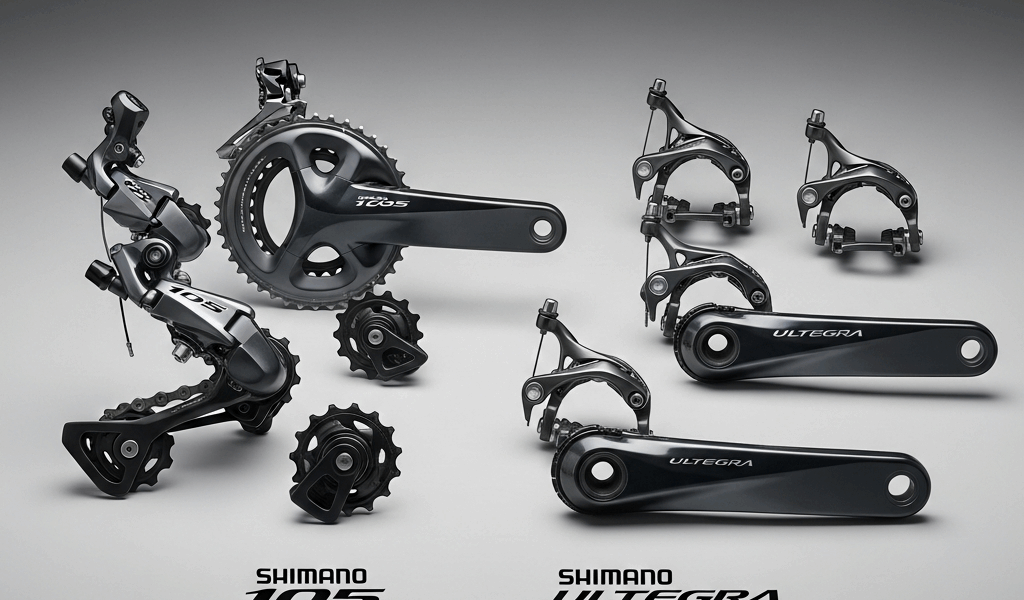
Shimano 105 vs Ultegra — Is the Upgrade Worth $500?
The shimano 105 vs ultegra debate has become harder to navigate with all the gear-obsessed noise flying around cycling forums, bike shop counters, and group ride arguments that somehow never end. As someone who’s been riding both groupsets for three years — 105 Di2 on my training bike, Ultegra Di2 on my race build — I put in the hours studying where these two actually differ. The honest answer is going to disappoint a lot of Ultegra evangelists. For most riders, the upgrade is not worth it. Here’s exactly why, and the narrow circumstances where it actually is.
This article includes affiliate links. We may earn a commission at no extra cost to you.
Shimano 105 vs Ultegra — What You Actually Get for the Extra Money
Raw facts first. The weight difference between a complete 105 Di2 groupset and a complete Ultegra Di2 groupset sits at approximately 373 grams. The lever feel on Ultegra is marginally better — slightly more tactile, a hair more refined. Ultegra also carries multi-region compatibility maps baked into the firmware, which matters if you’re running technical race routes and want more tailored shift logic.
That’s it. Genuinely. That’s the full list.
The shifting performance — the thing you’re actually paying for when you buy an electronic groupset — is functionally identical. I rode back-to-back weeks on both bikes last spring, deliberately hunting for a difference in shift speed, precision, and reliability under real load. On a 12% climb in the 34/28 combination, both groupsets performed the same. Both shifted instantly. Neither skipped. Neither hesitated. Not once.
Shimano’s engineers closed the performance gap significantly when they pushed 12-speed Di2 across both tiers. The 105 Di2 — groupset code ST-R7100 — runs the same fundamental shift logic and motor actuation as the Ultegra Di2 ST-R8100 series. The internal firmware differs, the finish varies slightly, the materials shave a bit more weight on the Ultegra side — but the rider experience at a Saturday morning pace is not meaningfully different.
Quick note before the rest of this, because everything else in this comparison flows from that single point: the performance gap that used to separate these two groupsets is largely gone.
What the Spec Sheet Doesn’t Tell You
The weight savings figure — 373 grams — looks significant written down. In real life, it’s one medium bidon. A full water bottle. The kind of weight you’d drain in the first 45 minutes of a summer ride and never think about again. Gram-counting is a cycling religion and I’m genuinely not here to mock it. But context matters, and this particular number needs some.
The lever feel difference is real — just subtle. Ultegra hoods use a slightly denser rubber compound and the shift paddle action returns with a marginally crisper snap. After three months on Ultegra, switching back to 105 Di2 levers for a week felt fine. Not degraded. Fine. Hand either set to a non-cyclist and they’d feel absolutely no difference whatsoever.
Where the Weight Difference Actually Matters
Racing. That’s where 373 grams matters. Specifically in timed climbing segments, criteriums where you’re hammering out of corners repeatedly, or any context where you’re competing against other riders and marginal gains stack into actual seconds on the clock.
Frustrated by my power-to-weight numbers two seasons ago, I went through every component on my race build looking for savings — obsessively, with a spreadsheet and a kitchen scale. The groupset swap from 105 to Ultegra was part of that build. In that context — building a dedicated race bike from scratch and accounting for every gram — Ultegra makes sense. You’re optimizing a whole system and the weight savings are real, even if modest in isolation.
Weekend riding. Sportives. Gran fondos. Commuting. Fitness riding. None of those use cases make 373 grams meaningful. The difference in your finishing time on a 100km Sunday ride between 105 Di2 and Ultegra Di2 is essentially zero. The variables that actually move the needle — your fitness, your tire pressure, whether you caught a tailwind on the return leg — dwarf the groupset weight difference completely. That’s what makes the 105 endearing to us regular riders who aren’t pinning race numbers every weekend.
The Durability Question People Always Bring Up
I want to address this one directly — the idea that Ultegra outlasts 105 or handles abuse better. Over three years and somewhere around 18,000 kilometres across both groupsets, I’ve had exactly one mechanical issue: a derailleur hanger strike on my 105 build that needed a replacement hanger — R7100 hanger, £8 from my local shop, sorted in ten minutes. The Ultegra groupset has been flawless. So has the 105, for everything except that hanger strike that had nothing to do with the groupset itself.
Chain wear rates have been similar across both. The Shimano CN-HG601 chain on the 105 and the CN-HG701 on the Ultegra both showed 0.5% wear after approximately 3,000 kilometres of mixed riding. Both 11-34 12-speed cassettes look identical after a full season. Durability is simply not a meaningful differentiator here — whatever anyone in a forum thread tells you.
When Ultegra Is Worth the Upgrade
Here’s where I’ll give Ultegra its due, because there is a genuine scenario where paying the premium makes real sense.
Complete bike purchases. This is the situation. When you’re buying a complete bike and the Ultegra version comes specced with better wheels, a carbon frame upgrade, or meaningfully better finishing kit, the price gap between the two complete builds isn’t really about the groupset anymore. You’re buying a better overall package — the Ultegra groupset is almost incidental to the value calculation at that point.
A friend spent weeks agonizing over two versions of the same manufacturer’s endurance road bike last year. The 105 Di2 build came with aluminium rims and a slightly heavier frame variant at £3,200. The Ultegra Di2 build was £3,800 and included a full carbon frame and an upgraded wheelset. That £600 difference wasn’t about the groupset. It was about the frame and wheels. He bought the Ultegra build and got every penny’s worth — not because of the derailleur, but because of everything else bundled into that package.
Racing with a dedicated race licence and real competitive goals at category level — that’s the other scenario. If you’re a Cat 3 or Cat 4 racer building the lightest, best bike you can afford and sourcing components individually, Ultegra is a reasonable call. The weight savings matter in that context. The slightly better lever feel matters when you’re logging six hours a week with specific intent to compete.
Those are the two scenarios. Outside of them, the groupset alone does not justify the premium.
What About Upgrading an Existing Bike
Swapping a 105 Di2 groupset for Ultegra Di2 on a bike you already own is almost never worth doing. You’re spending roughly $500 to $600 USD — or £450 to £500 depending on current UK pricing — for 373 grams of savings and a marginal lever feel improvement. That same money on better tyres — Vittoria Corsa Pro at £65 each, Continental GP5000 S TR at around £55 — will deliver a more noticeable real-world performance difference than the groupset swap ever could. Better wheels makes an even larger difference. A proper bike fit makes a larger difference than all of them combined.
Avoid the path I took. Early in my riding life I did a partial groupset swap on a mechanical build, replacing the rear derailleur thinking I’d feel the improvement immediately. Learned nothing from the experience except that I’d burned money that would have been far better spent on a power meter.
The Verdict — Save Your Money Unless Racing
105 Di2 for 99% of riders. Full stop. The shifting performance is identical to Ultegra, the durability is comparable, and the weight difference is irrelevant outside of competitive racing. If you’re buying a complete bike and the Ultegra version includes a meaningfully better frame or wheelset, buy it — but understand you’re buying those components, not the groupset upgrade itself.
Ultegra only makes sense if you’re actively racing, building a dedicated race bike from scratch, or if a complete bike package makes the price difference genuinely worthwhile based on other components in the spec sheet. Specific, narrow circumstances — all of them.
Tormented by groupset FOMO after reading too many gear review sites, most cyclists apparently spend money on components when they’d gain far more from training, tyres, or a professional bike fit. Ride the 105. Put the $500 toward a power meter or a structured training plan. You’ll go faster — probably a lot faster than 373 grams would ever manage.

Leave a Reply