How to Tell Your Saddle Is Actually Too High
Road bike saddle too high causing lower back pain has gotten complicated with all the conflicting advice flying around cycling forums, and I spent three frustrating months dealing with it myself before I actually measured anything. The problem feels vague at first—just generalized lower back tension—which is why most riders assume they need to stretch more or strengthen their core. They don’t. The saddle is usually just sitting too high.
Here’s what too-high saddle posture actually does to your body. Your pelvis tilts forward to reach the pedals at the bottom of the stroke when that saddle sits elevated. This anterior pelvic rotation forces your lower back to arch excessively and hold that arch for every pedal revolution—hundreds of times per ride. Your lumbar spine compresses into a hyperextended position. After an hour, this becomes chronic tension. After ten rides, it becomes pain.
The symptoms stack up fast, honestly. You’ll notice yourself reaching for the pedals rather than having a natural leg extension. Your lower back feels tight—not muscles, but deeper, like the joints themselves are compressed. Your hips might rock side to side in the saddle as you try to compensate for the reach. Sit bones go numb because the saddle angle has tilted your weight forward onto soft tissue instead of bone. Sometimes one side feels worse than the other.
I made the mistake of assuming my back pain was postural. I bought an expensive ergonomic office chair—cost me $340—did planks five days a week, and wore a posture brace during rides. None of it mattered because the root cause was 3 centimeters of saddle height I didn’t need. That’s the difference between treating symptoms and fixing the actual problem.
Measure Your Saddle Height Using the Heel Method
Forget the trial-and-error game. This method takes five minutes and gives you a repeatable baseline.
First, get your bike in a stationary trainer or have someone hold it steady. You need the crankarm at the bottom of the pedal stroke—what cyclists call 6 o’clock position. Clip into your pedal normally, but here’s the diagnostic part: place only your heel on the pedal, not the ball of your foot. Your heel should sit flat on the pedal without your leg extending fully. Your knee should be nearly straight—not locked, not bent. There should be maybe 5 to 10 degrees of bend, if any.
Now unclip and return your foot to normal cleat position. This time your foot contacts the pedal with the ball of your foot, the way you actually ride. Look at your knee bend. It should angle between 25 and 35 degrees. Not more, not less. This is the range where your glutes and quads work efficiently without forcing your spine into compensation patterns.
If your heel-to-pedal position already has 20 degrees of knee bend? Your saddle is too high. Lower it immediately. If your normal riding position puts your knee bend above 40 degrees? Your saddle is too low—that usually causes knee pain instead, not back pain.
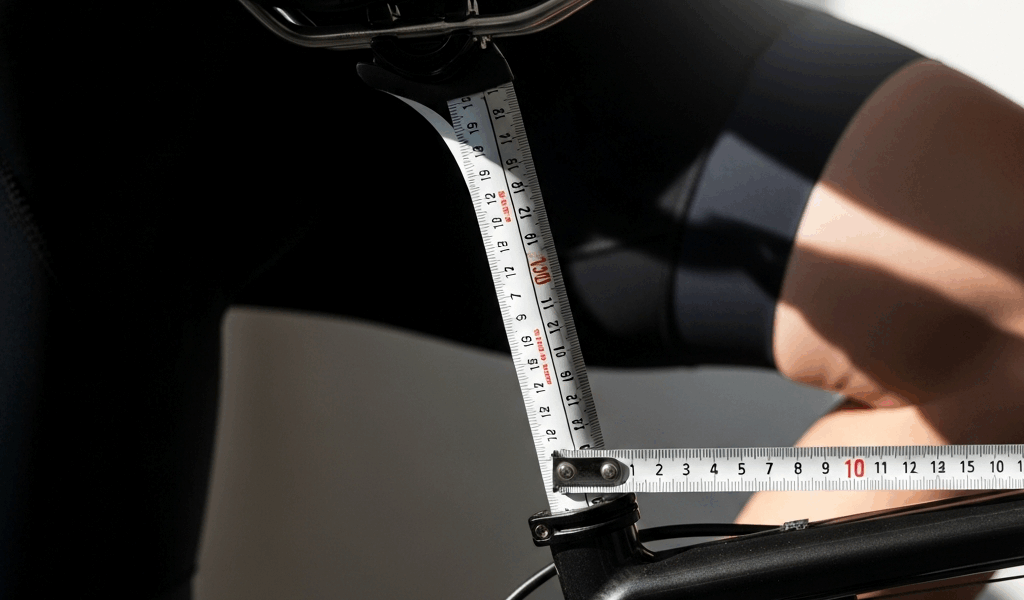
Write down your saddle height in millimeters before you adjust anything. I use a measuring tape from the center of the crank axle straight up to the top of the saddle. Mine sits at 725mm. Yours will be different based on your inseam, but the measurement method stays the same. This number matters later because you’re going to adjust in tiny increments, and you need to know exactly where you started.
Lower Your Saddle in Small Increments
Here’s where impatient riders fail. They drop the saddle 10 or 15 millimeters in one adjustment, immediately feel better, and think they’re done. Then they feel worse three days later because their body hasn’t adapted to the new position, or because other fit elements—stem length, bar drop—now feel off relative to the new saddle height.
Lower 5 millimeters. That’s one full turn on most saddle adjustment bolts. Ride 10 to 15 miles on a route where you can really feel your lower back—rolling hills work better than flat pavement because the hills load your spine differently.
How do you know if 5mm worked? Back pain should decrease noticeably. Not vanish—decrease. You’re looking for a 30 to 40 percent reduction in tension. You’ll also feel slightly more forward pressure in the saddle, which is correct. Your sit bones will carry more weight. If pain is completely gone after one 5mm drop, you probably went too far and need to raise it 2 or 3mm.
Small moves matter because of muscle memory. Your body has been pedaling with a certain pelvic angle for months or years. Changing it dramatically overnight causes muscle soreness that has nothing to do with saddle height—it’s just adaptation. Small 5mm drops spread that adaptation across four or five rides instead of creating acute discomfort in a single session. You also avoid overshooting, which requires raising the saddle again and repeating everything.
Give each adjustment two rides minimum before going lower. Three rides is better. If pain stops improving after the first drop, your saddle height wasn’t the problem—see the section below.
What to Do if Your Reach Now Feels Too Long
Probably should have opened with this section, honestly. When you lower the saddle, your torso position relative to the handlebars changes. The reach to your bars feels longer because your hips sit lower. This feels weird and makes you want to raise the saddle again.
Don’t. Instead, adjust your stem. A 10mm shorter stem pulls the bars closer to your body without changing saddle height. You can also increase bar drop by rotating the stem downward, which shifts weight forward and compensates for the new saddle position. Most road bikes come with stems that are longer than necessary anyway—I went from 120mm to 110mm on my Trek, a $30 fix that takes ten minutes with an Allen wrench.
The key point: saddle height and reach are separate fit variables. Solve them separately. Fix the back pain first with saddle height, then address reach comfort with stem adjustments.
When to Ignore Saddle Height and See a Fitter
Not all lower back pain is saddle-height pain. Red flags that point toward something else: pain that persists after 50 miles of riding with your new saddle height, meaning your body has had enough time to adapt and it’s still unhappy. Pain in your knees or hips rather than lower back—that suggests overall fit issues beyond saddle height. Asymmetrical discomfort, where one side of your back hurts much more than the other, often indicates a strength imbalance or a structural issue that bike fit can’t solve alone.
Bike fit is interconnected. Saddle height affects knee angle, which affects hip angle, which affects spinal load. Sometimes lower back pain needs a full professional assessment—not just saddle height measurement, but cleat position, seat angle, stem length, and core strength evaluation all together. A good fitter costs $150 to $250 and saves you months of guessing.
The heel method works for 80 percent of riders with high-saddle back pain. It’s precise, repeatable, and it’s the first thing any bike fitter checks anyway. Start here, adjust in 5mm drops, give each adjustment two rides, and most of your pain will disappear within a week. If it doesn’t, that’s when you make the fitter appointment knowing you’ve already ruled out the most common cause.

Leave a Reply